
2026 Environmental Compliance Guide for Paper POP Displays
What brand owners and procurement teams must know about the evolving regulatory landscape — and how to stay ahead.
2026 is a watershed year for packaging environmental regulations. From the EU's sweeping PPWR to state-level PFAS bans in the United States and expanded EPR schemes across Asia-Pacific, the compliance landscape for paper POP displays has never been more demanding — or more consequential.
For brand owners and procurement professionals, understanding these regulations isn't just about avoiding fines. It's about protecting brand reputation, ensuring market access, and turning compliance into a competitive advantage. Paper displays — when properly designed and certified — offer a natural path to compliance that plastic and mixed-material alternatives cannot match.
Key takeaway: The paper POP display is uniquely positioned as the most regulation-ready retail merchandising format in 2026. But only if your supply chain can provide proper certification, material declarations, and design documentation.
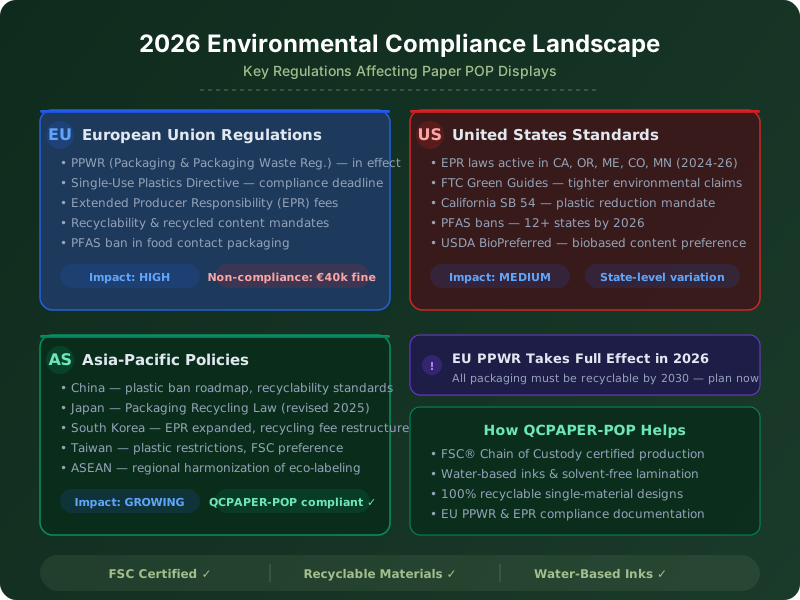
Overview of the major regulatory frameworks affecting paper POP displays in 2026
Key Regulations Affecting Paper POP Displays in 2026
EU — PPWR (Packaging & Packaging Waste Regulation)
Impact: HighEffective: Full effect 2026-2030
The EU PPWR is the most comprehensive packaging regulation globally. It mandates that ALL packaging must be fully recyclable by 2030, sets recycled content targets for plastic packaging, and requires standardized labeling. For paper POP displays, this means single-material design (no mixed materials that hinder recyclability), water-based inks only, and complete recyclability documentation. Non-compliant displays risk being banned from the EU market.
EU — Extended Producer Responsibility (EPR)
Impact: HighEffective: Active in all EU member states
Under EPR, brand owners and importers are financially responsible for the end-of-life management of packaging waste. Each EU country has its own EPR fee structure based on material type, weight, and recyclability. Paper displays that use mono-materials and achieve 'good recyclability' ratings pay lower EPR fees. Mixed-material displays face surcharges. For brands importing into Europe, proper EPR registration in each market is mandatory.
EU — PFAS & Chemical Restrictions
Impact: Medium-HighEffective: 2026-2027 phase-in
The EU is phasing out per- and polyfluoroalkyl substances (PFAS) in food contact packaging. For POP displays used in food retail environments, this directly affects grease-resistant coatings. Paper displays must switch to PFAS-free alternatives. QCPAPER-POP uses silicon-based and clay-coated PFAS-free barrier technologies that meet the upcoming restrictions.
US — State-Level EPR & PFAS Bans
Impact: MediumEffective: Rolling 2024-2026
Unlike the EU, the US has no federal packaging law. Instead, individual states are acting: California (SB 54), Oregon, Maine, Colorado, and Minnesota have EPR laws. 12+ states have PFAS bans in food packaging. The FTC Green Guides (updated 2025) strictly control environmental marketing claims. Brands with multi-state retail distribution must comply with the strictest state requirements or risk litigation.
China — Plastic Ban & Recycling Standards
Impact: MediumEffective: 2025-2026 expansion
China's plastic pollution control plan restricts single-use plastics in retail and encourages paper-based alternatives. New recycling standards (GB/T series) require clear material labeling. For brands manufacturing with QCPAPER-POP in China, our paper displays are naturally compliant with the plastic restrictions, and our production follows China's latest environmental standards for VOC emissions and wastewater treatment.
Asia-Pacific — Japan, Korea, Taiwan, ASEAN
Impact: MediumEffective: 2025-2027
Japan's revised Packaging Recycling Law (2025) requires producers to reduce packaging weight. South Korea's EPR system restructured fees in 2025 with higher penalties for non-recyclable packaging. Taiwan mandates FSC preference for paper products in government procurement. ASEAN countries are harmonizing eco-labeling standards. Brands operating across APAC should adopt a single high-compliance standard to simplify cross-border logistics.
Why Paper POP Displays Excel in the 2026 Compliance Landscape
The 2026 regulatory environment creates a structural advantage for well-designed paper displays:
Naturally Recyclable
Paper is the most recycled material globally (~68% recycling rate in EU). Single-material paper displays require no disassembly for recycling.
Plastic-Free Default
Paper displays don't need plastic components to function. This automatically complies with single-use plastics directives and PFAS restrictions.
Renewable Source
FSC-certified paper comes from responsibly managed forests — a renewable resource that aligns with circular economy principles.
Lower EPR Fees
Recyclable paper packaging with good de-inking properties qualifies for the lowest EPR fee bands in most EU and US state schemes.
Carbon Advantage
Paper displays have a lower carbon footprint than plastic or acrylic alternatives, especially when manufactured with renewable energy.
Compliance Documentation
Established certification schemes (FSC, PEFC) provide ready-made compliance documentation that regulators recognize.
Compliance Checklist for Procurement Teams
Ensure your POP display supplier can provide the following documentation for every production run:
- FSC® Chain of Custody certification for every production run
- Material recyclability declaration (ISO 14021 compliant)
- Single-material design (avoid plastic lamination, metal rivets)
- Water-based inks and solvent-free adhesives
- PFAS-free coating verification (if food-contact use)
- EPR registration documentation for EU markets
- Recycled content percentage declaration
- Product carbon footprint data (Scope 1-2-3)
- REACH & RoHS compliance for any non-paper components
- Supplier audit documentation (environmental management)
Compliance Requirements by Market
| Requirement | EU | US | China | APAC |
|---|---|---|---|---|
| FSC Certification | Recommended | Recommended | Preferred | Growing |
| Recyclability Declaration | Mandatory | State-level | Standard | Varies |
| EPR Registration | Mandatory | States (CA, OR, ME, CO, MN) | N/A | Korea, Japan |
| PFAS-Free | Mandatory (2027) | 12+ states by 2026 | Restricted | Japan, Korea |
| Recycled Content | Targets set | Voluntary | Standard | Varies |
| VOC/Emissions Control | Strict | EPA standards | Strict (2025+) | Varies |
| Carbon Footprint Data | Expected | Voluntary | Emerging | Emerging |
Requirements vary by specific product use and retail channel. Consult your compliance team for market-specific obligations.
Common Compliance Mistakes to Avoid
❌ Assuming paper is automatically compliant
✓ Paper must still meet recyclability standards — coatings and laminations can disqualify it
❌ Using generic recycled content claims
✓ Specify exact recycled percentage and source (pre-consumer vs post-consumer)
❌ Ignoring EPR registration until products ship
✓ EPR registration takes 4-8 weeks per country — plan ahead in your production timeline
❌ Accepting verbal sustainability promises
✓ Request written certificates, material declarations, and audit reports for every claim
❌ Designing for aesthetics without end-of-life
✓ Consider de-inking, repulpability, and disassembly during the structural design phase
❌ Overlooking state-level US variations
✓ Federal preemption does not apply — track requirements in each state where your displays are used
2026-2030 Compliance Timeline
•EU PPWR delegated acts published
•US state EPR laws take effect (MN, CO)
•California SB 54 plastic reduction target
•China expanded recycling standards
•EU PFAS restriction in packaging effective
•Korea EPR fee restructure fully applied
•France AGEC law — display ban for non-recyclable
•EU PPWR — recycled content targets for plastic packaging
•Japan revised Recycling Law full enforcement
•ASEAN eco-labeling harmonization target
•EU — ALL packaging must be recyclable
•California SB 54 — 65% reduction target
•Global plastic pollution treaty potential effect
QCPAPER-POP: Your Compliance-Ready Partner
We provide FSC® Chain of Custody documentation, material recyclability declarations, EPR compliance paperwork, and PFAS-free material guarantees for every project. Our paper POP displays are designed from the ground up for regulatory compliance across global markets.
FSC Certified
Chain of Custody
Recyclable
Single-material design
Compliant
EU PPWR, EPR ready